




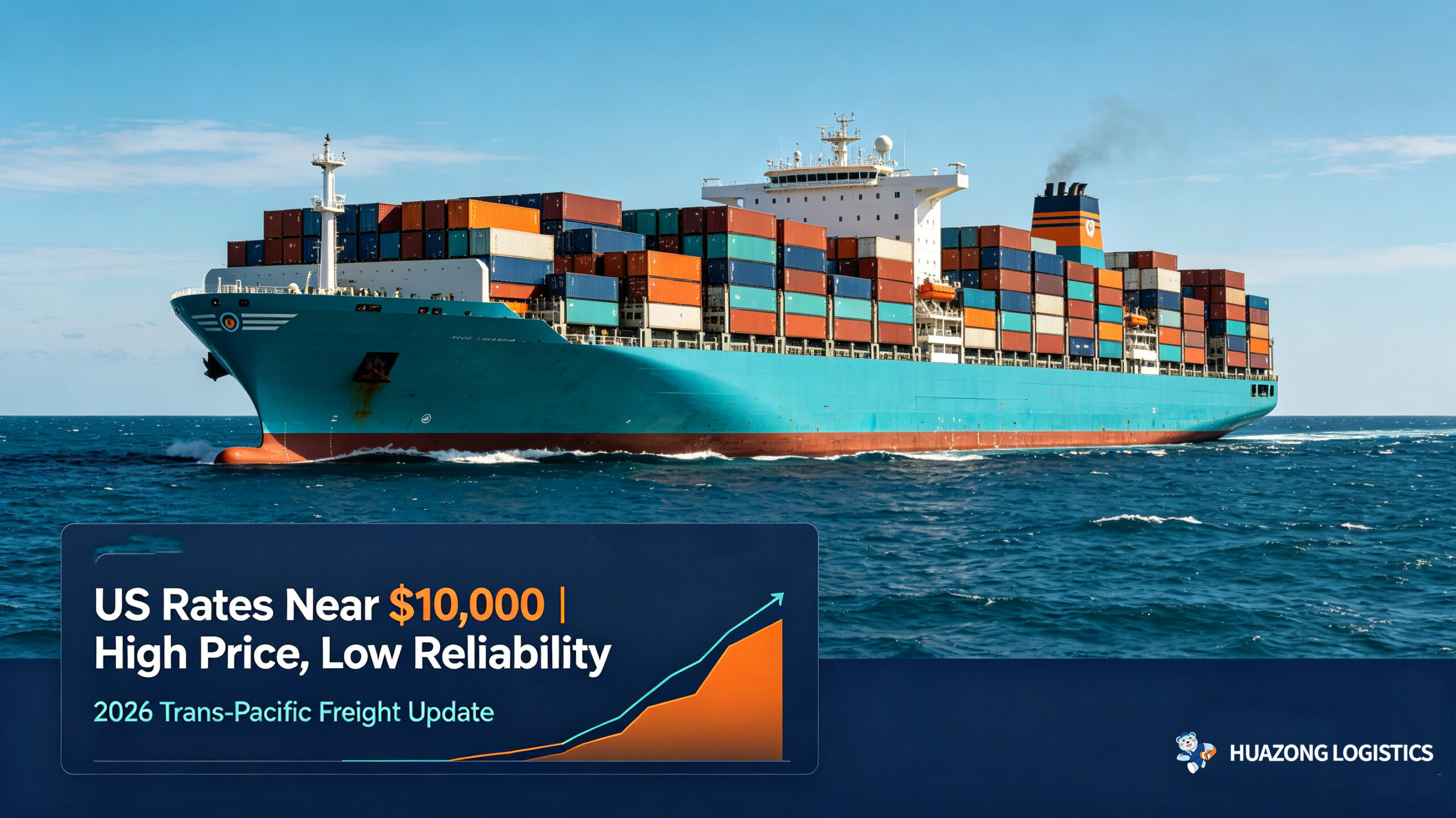
Since the start of September, the global container shipping market has shown clear divergence. US trade lane rates continue climbing, with spot rates for Shanghai to New York and Los Angeles rising in tandem, while Asia-Europe rates keep declining.
Yet higher freight costs have not translated into more stable service. Latest data shows global container schedule reliability has fallen to 29.4%, and on-time performance on Far East-North America routes has dropped from 38% to 19%.
Shanghai – New York Rates Approach $10,000 per FEU
According to the latest World Container Index (WCI) from Drewry, released September 3, spot rates for 40ft containers from Shanghai to New York rose 3% week-on-week to **$9,587/FEU**, edging close to the $10,000 threshold.
Shanghai to Los Angeles rates also climbed 5% to $7,185/FEU.
Year on year, Shanghai-New York rates are now nearly triple the level seen in the same period last year, when the lane stood at around $3,677/FEU.
Further data from Xeneta shows that as of September 3, average spot rates for Far East to US East Coast reached $10,910/FEU, up 1.6% week-on-week. Far East to US West Coast rates hit $7,496/FEU, a 2.5% weekly increase.
Compared with levels before the Middle East conflict broke out in late February, rates on the two lanes have surged 305% and 289% respectively. Currently, average Far East-US East Coast rates are just 14% below the all-time pandemic peak set in 2022.
Peak Demand + Carrier Capacity Controls Keep Rates High
This latest trans-Pacific rate surge is not driven by a single factor.
The Loadstar cited Freight Right as noting that US West Coast cargo volumes rose around 9% week-on-week recently, with East Coast volumes up about 3%, indicating peak season demand remains supportive.
At the same time, carriers continue to tighten supply through blank sailings, route call adjustments and capacity cuts on select services.
A new round of General Rate Increases (GRIs) effective September 1 has provided further upward momentum. The Loadstar reports that following partial implementation of this GRI round, some West Coast quotes rose by $300 to $500 this week.
Capacity contraction continues. Drewry data shows 6 blank sailings have already been announced on trans-Pacific routes for next week – double the number this week. With demand still resilient, Drewry expects trans-Pacific spot rates to at least remain stable next week.
Higher Rates, Worse Schedule Reliability
Alongside rising prices, shippers are facing deteriorating schedule performance.
Xeneta data shows global container schedule reliability fell to 29.4% in August 2026, down further from the 30-month high of 39% recorded in May.
This means fewer than 3 in 10 container vessels worldwide arrive on schedule. On Far East-North America routes specifically, schedule reliability dropped from 38% in mid-June to 19% by the end of July. Port closures, congestion and vessel backlogs caused by Asian typhoon season are major contributors to the recent deterioration.
Performance also varies significantly across major alliances:
- Gemini: 51.8%
- Ocean Alliance: 27.7%
- Premier Alliance: 15.8%
- MSC standalone services: 26.0%
Global schedule reliability has now fallen for three consecutive months, highlighting a stark market reality: shippers are paying increasingly high freight rates, but receiving less and less schedule stability.
US Rates Rise, Europe Rates Fall
In sharp contrast to the US market, Asia-Europe rates are trending downward.
Drewry data shows Shanghai-Rotterdam rates fell 5% this week to $4,092/FEU, while Shanghai-Genoa rates dropped 10% to $4,368/FEU.
Only 1 blank sailing is planned on Asia-Europe routes next week, down from 4 this week. With more capacity entering the market and weakening cargo demand, Drewry expects Asia-Europe spot rates to continue declining slightly next week.
Xeneta data confirms the trend: as of September 3, average Far East-North Europe rates stood at $4,532/FEU, down 3.3% from the end of August. Far East-Mediterranean rates hit $5,072/FEU, down 5.6% week-on-week.
Overall, the container shipping market is not seeing a universal rate increase. Instead, it presents a clear “US strong, Europe weak” pattern.
For forwarders and shippers, the sustainability of high US rates will depend on whether peak season volumes continue, and how tightly carriers control trans-Pacific capacity. For now, at least based on next week’s capacity schedule, there is no obvious room for US rate cuts.
Navigate Trans-Pacific Rate Volatility With Huazong Logistics
As a professional freight forwarder with mature trans-Pacific trade lane expertise, Huazong Logistics helps shippers manage high US rates and unreliable schedules with stable, cost-effective logistics solutions:
- Guaranteed Space Booking – Secure confirmed container space on major trans-Pacific carriers, even during peak season and capacity tightening, avoiding rollovers and shipment delays.
- Transparent Rate Lock Options – We offer both spot and contracted rate structures, with clear GRI and surcharge visibility to help you budget and forecast shipping costs accurately.
- Proactive Schedule Tracking – Real-time vessel tracking, delay alerts and schedule updates, so you can plan inventory and distribution around schedule fluctuations.
- Alternative Routing Solutions – When schedule reliability is critical, we offer West Coast, East Coast and intermodal routing options to balance cost, transit time and delivery certainty.
- End-to-End US Delivery – Full-service support from China origin pickup, export customs clearance, ocean freight to US import clearance, drayage and final-mile delivery nationwide.
For businesses shipping to the US amid high rates and schedule uncertainty, partnering with Huazong Logistics delivers reliable, proactive trans-Pacific logistics support.


