




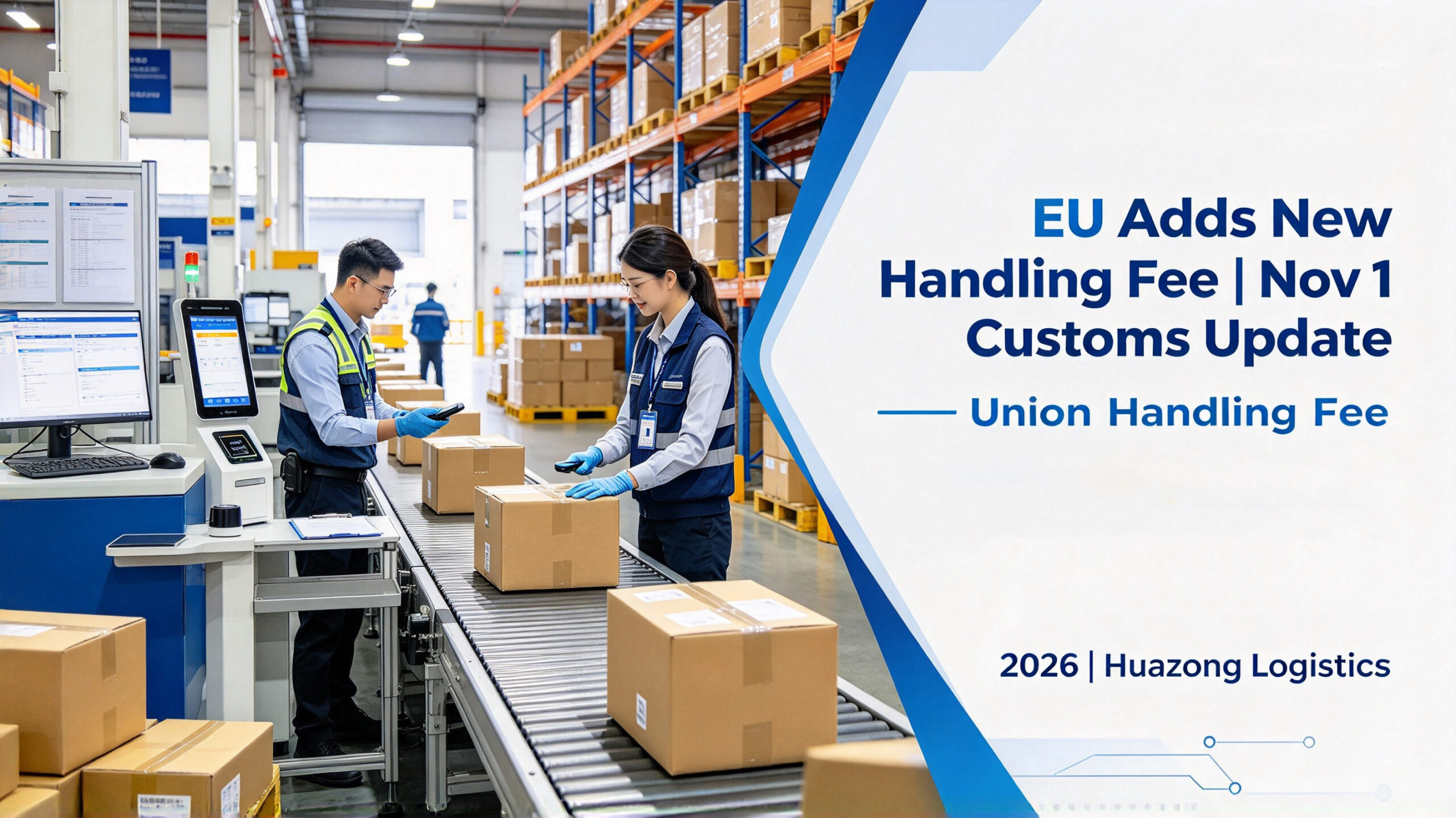
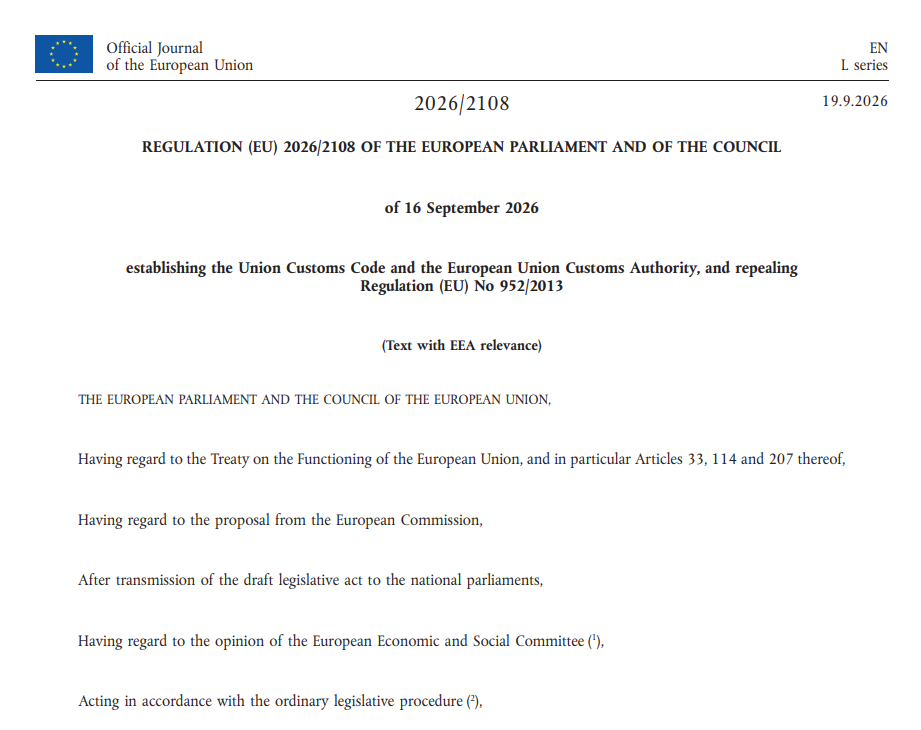
On September 16, the European Parliament and the Council of the EU formally adopted the revised Union Customs Code (UCC). Under the new legislation, a uniform EU Union handling fee will be introduced for goods entering the EU via e-commerce distance sales, with the provisions set to enter into force no later than November 1, 2026.
For businesses operating in EU cross-border e-commerce logistics, dedicated line services, overseas warehousing and customs clearance, the reform is restructuring the cost and liability framework for small-parcel imports into the bloc.
On September 16, the European Parliament and the Council of the EU formally adopted the revised Union Customs Code (UCC). Under the new legislation, a uniform EU Union handling fee will be introduced for goods entering the EU via e-commerce distance sales, with the provisions set to enter into force no later than November 1, 2026.
For businesses operating in EU cross-border e-commerce logistics, dedicated line services, overseas warehousing and customs clearance, the reform is restructuring the cost and liability framework for small-parcel imports into the bloc.
New Union Handling Fee Launches November 1
Under the new Union Customs Code, the EU will levy a standard Union handling fee on goods sold via distance sales to EU consumers. The fee is designed to cover customs processing costs, including data verification, risk analysis, infrastructure operation and mandatory inspections.
The exact fee rate has not yet been published and will be determined separately by the European Commission.
The regulation also specifies that the handling fee will be lower for goods processed through customs warehouses dedicated to cross-border e-commerce distance sales, compared to standard direct import channels.
In practical terms, cross-border e-commerce parcels entering the EU after November will face a new cost structure, though it cannot yet be simplified as a flat per-parcel charge in euros.
The €3 Tariff Is Separate From the November Fee
Another major change to EU low-value import rules is already in effect. Since July 1, 2026, the EU has eliminated its previous €150 de minimis tariff exemption and imposed a temporary €3 tariff on low-value e-commerce imports valued at up to €150.
This €3 tariff and the upcoming Union handling fee are two separate charges, not one and the same.
Furthermore, the €3 tariff is not calculated as a flat €3 per parcel. Instead, it is levied per product category within a shipment. For example, a parcel containing two different categories of goods would incur a temporary tariff of €6.
This temporary arrangement is scheduled to remain in force until July 1, 2028, after which the goods will become subject to standard import duties.
Platforms & Sellers Take On Greater Import Liability
Another core change in the customs reform is the shift of import responsibility toward e-commerce operators. The new rules explicitly state that when a non-EU e-commerce platform sells goods to EU consumers, the platform is deemed the importer of record and is responsible for customs formalities and associated duties and taxes, rather than placing the primary burden on end consumers.
Platforms and sellers are also required to ensure goods comply with EU laws and standards, and to submit all required data to customs authorities.
The reform introduces stricter penalty mechanisms for e-commerce operators that persistently fail to meet customs obligations. In cases of serious non-compliance, fines can reach up to 6% of the value of the enterprise’s imports in the preceding year, and may also include withdrawal of certain customs privileges or even restrictions on platform access to the EU market.
Why the EU Is Tightening Parcel Import Rules
European Commission data shows that 5.9 billion low-value e-commerce items entered the EU in 2025 – four times the volume recorded in 2022.
This massive inflow of small parcels has placed growing pressure on EU customs systems for data processing, risk identification and compliance screening. The reform is therefore not only a cost adjustment, but also a broader overhaul of the EU’s customs data and regulatory framework.
Notably, the preferential handling fee rate for e-commerce customs warehouses aligns with the EU’s earlier policy direction: encouraging non-EU sellers and platforms to operate warehouses within the bloc for bulk-processed goods, in order to reduce the processing strain caused by high volumes of individual small parcels entering the EU customs system one by one.
As the new rules take effect, the logistics model of bulk import + EU warehousing + domestic last-mile delivery is likely to benefit from more favorable cost conditions.
EU Cross-Border E-Commerce Rules Keep Evolving
From the abolition of the €150 de minimis exemption in July, to the introduction of the Union handling fee in November, and the phased rollout of the EU’s customs data system, the bloc is continuously updating its import rules for low-value cross-border e-commerce goods.
For platforms, sellers, logistics providers and customs brokers across the EU cross-border e-commerce supply chain, the changes ahead extend far beyond a single fee adjustment. They also cover declaration data requirements, import liability, compliance standards and logistics model restructuring.
The new Union Customs Code was published in the Official Journal of the European Union on September 19. The exact rate of the Union handling fee remains subject to further determination by the European Commission.
EU E-Commerce Logistics & Customs Compliance Support From Huazong Logistics
As a professional cross-border logistics provider with deep EU lane expertise, Huazong Logistics helps e-commerce sellers and platforms navigate the evolving EU customs landscape with compliant, cost-optimized logistics solutions:
- Regulatory Compliance Advisory – Our EU customs specialists track UCC updates, tariff changes and handling fee adjustments, providing pre-shipment compliance reviews to help you avoid penalties and customs delays.
- EU Overseas Warehouse Solutions – We offer bonded and general warehousing options across major EU hubs, enabling bulk import models that qualify for preferential Union handling fee rates and reduce per-parcel processing costs.
- Full-Service Customs Clearance – End-to-end import declaration, duty calculation and customs clearance support, with accurate per-category tariff handling aligned with the €3 temporary duty and new UCC requirements.
- Dedicated E-Commerce Parcel Lines – Stable, tracked dedicated air and road parcel lines from China to the EU, optimized for cross-border e-commerce shipments with transparent pricing and predictable transit times.
- Proactive Policy Monitoring – Real-time updates on EU customs rule changes, tariff adjustments and enforcement trends, so you can adapt your supply chain and pricing strategy ahead of regulatory deadlines.
For businesses selling into the EU amid changing customs rules, partnering with Huazong Logistics delivers reliable, compliant cross-border e-commerce logistics built for the new Union Customs Code era.


