




Westbound US freight volumes are rising while East Coast volumes are falling. Shipping lines are already restructuring their service networks. Freight forwarders focusing on US routes may will to adjust their pricing and booking strategies accordingly.
The Port of Los Angeles delivered a strong performance in April. Port authority data shows it handled 890,861 TEU in the month, a 5.7% year-on-year increase, making it the second-best April in history. Imported loaded containers reached 459,825 TEU, up 5% year-on-year and a sharp 21% month-on-month rise from March.
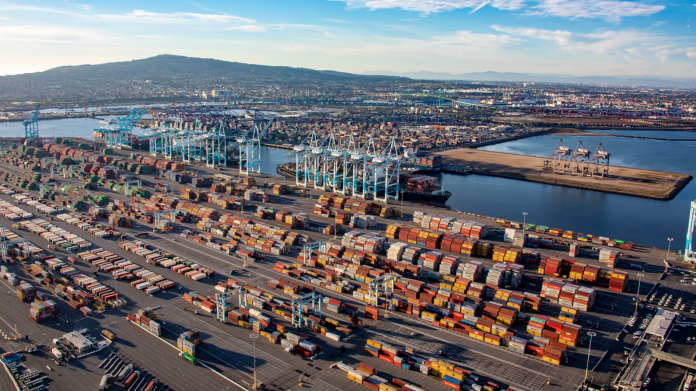
Gene Seroka, Executive Director of the Port of Los Angeles, commented: “April was our strongest month so far this year and the highest volume since August last year — a clear sign of resilient US consumer demand.” He added that booking trends from Asia indicate “the next wave of imports for back-to-school and early Christmas merchandise is already building up.”
· West Coast Up, East Coast Down
In sharp contrast to the West Coast, East Coast freight is being siphoned away.
According to the latest global shipping report by Descartes Systems Group, total US container imports in April 2026 stood at 2.28 million TEU, down 5.5% year-on-year and 3.2% month-on-month. The divergence between the East and West Coasts is widening: West Coast port market share is rebounding (Los Angeles +19.5% month-on-month, Long Beach +13.1%), while East Coast and Gulf Coast ports plunged 18% to 18.2% year-on-year.
The logic is clear: tariff policies and trade uncertainty are prompting importers to reroute cargo. The East Coast naturally relies on Suez Canal services, but ongoing instability in the Red Sea and the Strait of Hormuz has forced many carriers to sail around the Cape of Good Hope, extending transit times and driving up costs. The direct Pacific route to the US West Coast is less exposed to Middle East tensions, making it a preferred alternative for risk-averse importers.
· Carriers Restructure Service Networks
Changing cargo flows are forcing shipping lines to reshape their global networks.
MSC has recently overhauled three of its Asia-to-US East Coast services — Empire, Amberjack, and Emerald:
- The Empire service removed Qingdao and added calls at Norfolk and Everglades, with an additional call at Rodman, Panama, on the backhaul.
- The Amberjack service set Qingdao as its first Asian port of call, dropping Yantian and Xiamen.
Qingdao’s role is shifting dramatically — dropped from one loop while becoming the starting port on another. For northern China exporters shipping to the US East Coast, choosing the right vessel and voyage has become more critical than ever. Locking in specific service codes during pricing is now more important.
· 3 Practical Shipping Tips for you
- Book space early for US West Coast shipments
More cargo is shifting from the US East Coast to the West Coast, which will keep increasing throughput at Los Angeles and Long Beach ports. Although operations are smooth now, peak season plus diverted cargo may lead to congestion. Secure your container space as early as possible, especially for back-to-school and Christmas goods.
- Understand potential rate adjustments for trans-Pacific routes
As cargo shifts to the West Coast, shipping lines have stronger pricing power on trans-Pacific routes. West Coast space is getting tighter, so you may see moderate rate adjustments. Plan your shipping budget in advance.
- Compare total cost and transit time for East Coast routes
Most vessels to the US East Coast now sail around the Cape of Good Hope, resulting in longer transit times, higher fuel costs, and elevated war risk surcharges. If you choose East Coast delivery, make sure you understand all extra fees and balance between speed and total cost.
Shipping lines are speeding up network adjustments. In the past month, MSC has revised both Asia–West Coast and Asia–East Coast route networks. The trans-Pacific shipping pattern is changing fast — now is the time to adjust your shipping plan accordingly.
Data sources: Port of Los Angeles official data, Descartes Systems Group Global Shipping Report, AINVEST Analysis, Sohu Finance


